
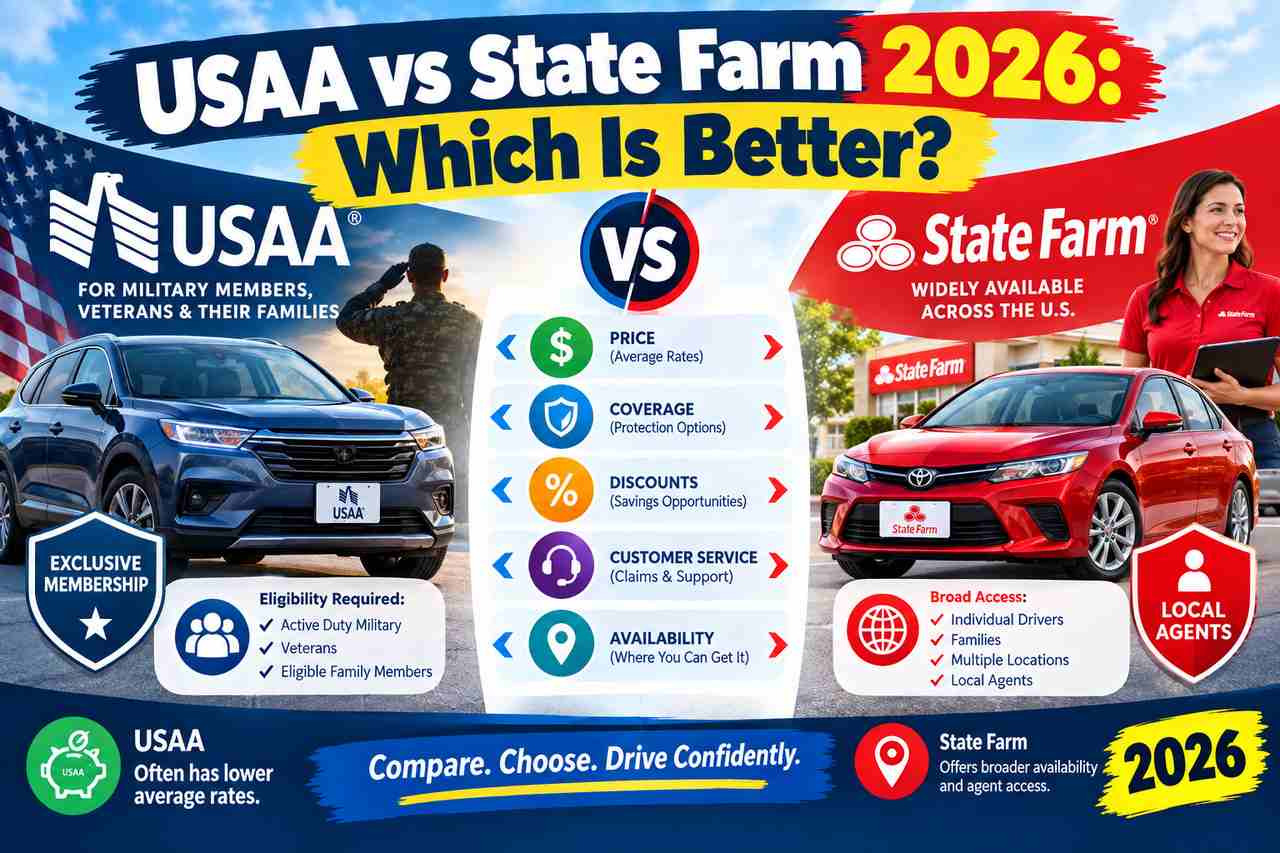
USAA is cheaper and consistently earns top marks for service — but only military members, veterans and their families can join. If you’re not eligible, State Farm is the strongest widely available alternative: solid prices, the largest agent network in the country, and good discounts for safe drivers and students. For most people, eligibility decides this before price does.
Side by side
| USAA | State Farm | |
|---|---|---|
| Full coverage / yr | ~$1,587 | ~$1,985 |
| Minimum coverage / yr | ~$352 | ~$561 |
| Who can join | Military & families only | Anyone |
| Agents | Mostly online/phone | Largest agent network |
| Satisfaction | Consistently top-rated | Strong |
| Best for | Low rates for the military | Drivers who want an agent |
Source: NerdWallet national average estimates, 2026. Varies by state, age, car, record and credit.
Which is cheaper?
USAA — noticeably so, often a few hundred dollars a year less than State Farm for the same driver, and it tends to top customer-satisfaction rankings. The catch is eligibility: if you or an immediate family member hasn’t served, you simply can’t buy it. State Farm is pricier than USAA but still competitive against the wider market, and it’s open to everyone.
What if you can’t join USAA?
Most people can’t — and that’s fine. If USAA’s off the table, State Farm is a dependable default, but it won’t automatically be your cheapest: in some states a regional insurer like Erie or Country Financial, or a big name like Geico, undercuts it. Your state matters too — the gap between these two widens or narrows depending on where you live. So treat State Farm as a strong starting quote, not the finish line, and compare it against one or two others.
A real example
Two drivers, same two companies, different answers. The first is a 40-year-old veteran with a clean record: USAA quotes $1,300, State Farm $1,650 — USAA wins by $350 a year, no contest. The second is his neighbor, not military, so USAA isn’t even an option; for her, State Farm’s $1,650 beats the market average and she loves having a local agent to call. Eligibility decided it for both before price ever entered the picture.
Who should choose each one
Choose USAA if…
- You’re active-duty, a veteran, or an immediate family member
- You want the lowest rates and top-rated claims service
- You’re comfortable handling things online and by phone
Choose State Farm if…
- You’re not eligible for USAA (most people)
- You want a local agent you can sit down with
- You have a teen or want good-student discounts
The bottom line
If you qualify for USAA, it’s usually the clear winner on both price and service — start there. If you don’t, State Farm is a dependable, widely available choice, especially if you value an agent — but compare it against a couple of others first. Not sure where to start? Our online quotes guide walks through it.
Let’s be real: this one’s barely a contest if you can get USAA. It’s cheaper, it treats its members well, and that’s why it quietly tops satisfaction lists year after year. If you’ve served or a parent or spouse has, check USAA first and you’ll probably stop there.
But most people can’t join, and that’s fine — I’d point them to State Farm, especially anyone who wants a real person down the road to call when a claim gets messy. Just don’t assume State Farm is automatically the cheapest; it’s competitive, not rock-bottom, so grab a couple of other quotes before you commit.
FAQs
Is USAA cheaper than State Farm?
Who can join USAA?
Is State Farm good for teen drivers?
Which has better customer service?
If I can’t get USAA, is State Farm my cheapest option?
Can family members use my USAA eligibility?
Sources: NerdWallet (2026 national average estimates).